

Call For A Free Consultation(602) 345-1818Free Case Review
 Fighting Suits,
Stories, animation and community. Created by Impact Legal.

We're Here To Help 24/7
(602) 345-1818Lane-Splitting Accidents in Phoenix: What Arizona’s Lane Filtering Law Actually Says
Updated October 30, 2026.
Arizona law draws a sharp line between limited lane filtering and ordinary lane splitting. This guide explains that line under A.R.S. § 28-903, including the road, traffic, speed, and passing conditions that must exist before filtering is allowed.
For fault, insurance, and evidence after an actual collision, see our Phoenix lane-filtering crash and claim guide.
Lane splitting generally describes riding between moving traffic. Arizona’s statute does not create a general permission for that practice.
Lane filtering is the narrower operation allowed by A.R.S. § 28-903 when the motorcycle, roadway, traffic, and speed conditions in the statute are satisfied. Use those conditions, not a label or an assumption about intersections, to classify the maneuver.
A.R.S. § 28-903 permits a two-wheeled motorcycle to pass another stopped vehicle in the same lane and operate between stopped vehicles in the same direction only when each statutory condition is satisfied.
The statutory text controls. It does not create a general permission to ride between moving traffic, and it does not say the maneuver is limited to a particular intersection layout. Apply the actual road, traffic, and speed facts.

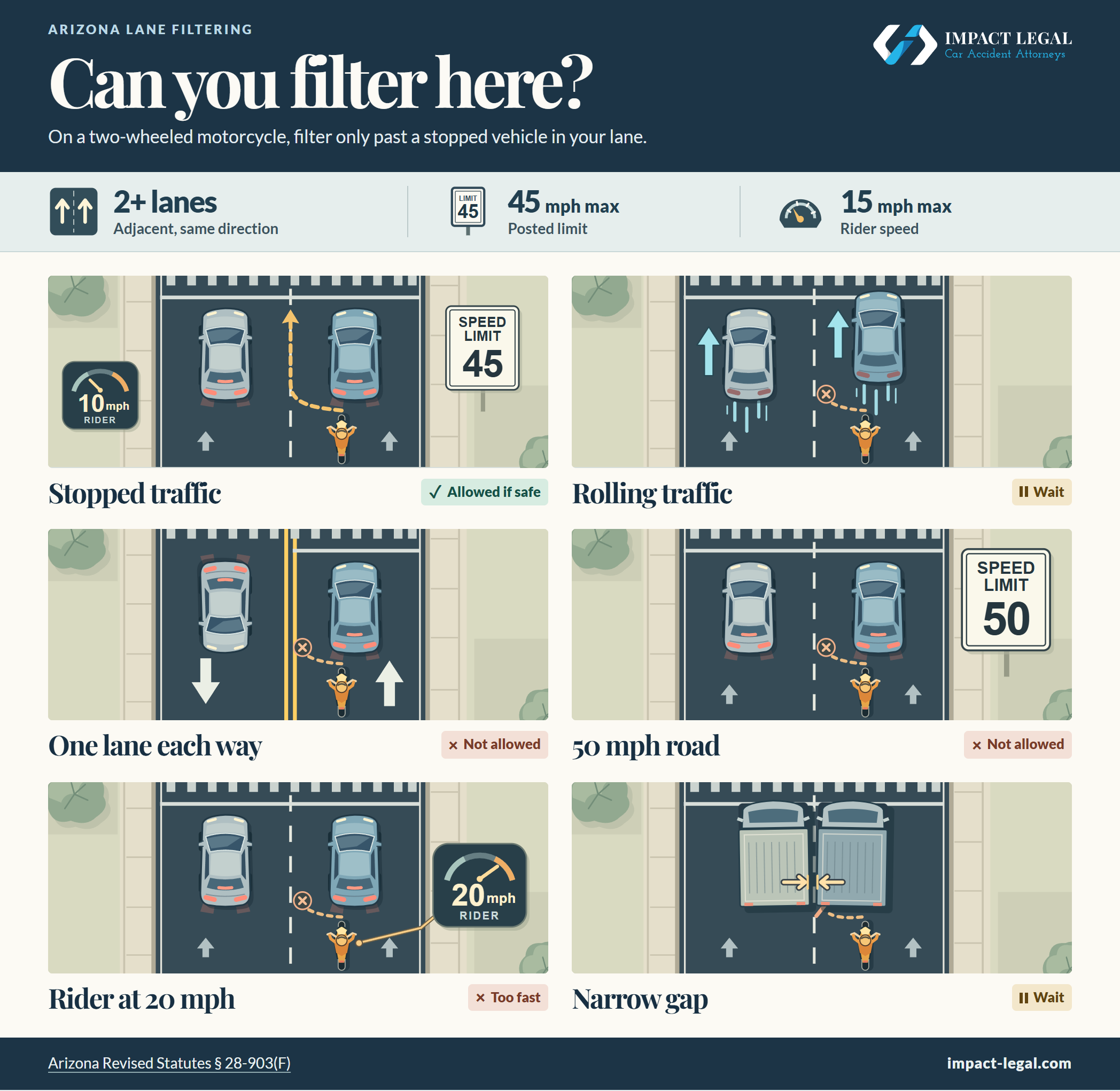
A rider on a two-wheeled motorcycle may filter past a stopped vehicle in the rider’s lane and direction when the street has at least two adjacent lanes going that way, the posted limit is 45 mph or less, the rider travels at 15 mph or less, and there is room to pass safely.
Meeting A.R.S. § 28-903 matters because it answers whether the rider was using the statute’s limited permission. It does not decide every fault question. A driver may still fail to look before moving. A rider may still contribute through speed, lane position, or another act. Responsibility depends on the full sequence.
Keep the rules analysis separate from the collision analysis. The statute addresses between-lane operation. It does not replace the ordinary duties that apply when a driver turns, changes lanes, opens a door, or enters an intersection.
Video, witnesses, vehicle positions, the police report, and time-stamped photographs may help answer those questions. Preserve the original files when possible. Note who created each item, when it was captured, and whether the file is an original or a later copy.
Conduct outside A.R.S. § 28-903‘s filtering conditions is not protected by the filtering provision. That fact may be relevant to fault, but the collision sequence and causation still require review. A.R.S. § 12-2505 generally reduces damages according to relative fault in an ordinary negligence claim. Section 12-2505(A) does not allow comparative negligence in favor of a claimant who intentionally, wilfully, or wantonly caused or contributed to the injury.
For a detailed fault analysis, see our Phoenix crash and claim guide.
A dispute often centers on the posted limit at the exact location, whether surrounding vehicles were stopped, the motorcycle’s speed, the number and direction of lanes, and whether the maneuver was made safely. Those are evidence questions. An insurer’s use of the word “splitting” does not resolve them.
Helmet use is a separate injury and damages issue that depends on the injuries, evidence, and applicable law. It does not determine whether the four filtering conditions existed.
Under A.R.S. § 12-2505, damages in an ordinary negligence claim may be reduced according to the claimant’s share of fault. Section 12-2505(A) does not allow comparative negligence in favor of a claimant who intentionally, wilfully, or wantonly caused or contributed to the injury. A statutory violation does not assign its own percentage, and lawful filtering does not eliminate every rider-fault argument.
The Phoenix crash and claim guide covers the collision evidence and fault analysis. Filtering legality and civil fault are related but distinct questions.
Medical harm, lost income, and other losses matter in a claim, but they do not tell you whether the maneuver qualified as lane filtering. Start with the road and traffic facts. Then evaluate fault, coverage, injuries, and losses through the appropriate claim guide.
That order keeps the statute from becoming a label. It also helps prevent an insurer from treating lawful filtering, unlawful splitting, and an ordinary lane change as if they were the same event.
If you can move and you’re not being loaded into an ambulance, these steps protect the claim:
An early description can affect how an insurer labels the maneuver. Be accurate about the direction of travel, traffic state, speed, road configuration, and vehicle movement. Do not guess about a speed or distance you cannot reliably recall.
If the dispute concerns what happened after a collision, the claim guide covers statements, evidence, insurance, and next steps in more detail.
A.R.S. § 12-542 generally provides a two-year period after accrual for many Arizona injury actions, subject to claim-specific accrual rules and exceptions. A public-entity claim may require notice within 180 days under A.R.S. § 12-821.01 and a separate lawsuit within one year under A.R.S. § 12-821. Policy-based claims can involve contractual duties and other timing questions.
UM and UIM coverage must be evaluated from the actual policy and written selection or rejection records. Do not assume policies can or cannot be combined without reviewing A.R.S. § 20-259.01 and the policy structure. Use the claim guide for the next-step framework.
A between-lane collision may overlap with a turning-vehicle, lane-change, or door-opening mechanism. Identify the actual movement and use the guide that addresses it. Do not assume one collision pattern proves another.
A between-lane collision can overlap with a door opening or another vehicle movement. See the motorcycle dooring guide for that distinct mechanism. The Arizona personal injury law guide provides broader context on fault and damages rules.
A useful analysis does not ask only whether a rider was “filtering.” It tests each condition in A.R.S. § 28-903 against the available facts. The road must have at least two adjacent lanes moving in the same direction. The posted limit must be 45 mph or less. The other vehicle must be stopped. The motorcycle must travel no faster than 15 mph. The operation must be safe.
One missing condition can place the maneuver outside the statute’s limited permission. The remaining facts still matter to the separate civil-fault analysis. For example, a rider’s speed does not erase evidence that a driver moved without looking. A driver’s unsafe movement does not prove that the rider met the filtering conditions.
A multilane city street can meet the lane-count requirement, but the posted limit must still be checked at the exact segment. A nearby sign, a municipal speed record, mapping imagery, or a time-stamped scene photograph may help. A general impression that the road “felt slow” is not the statutory test.
The statute refers to passing a stopped vehicle and operating between stopped vehicles. Slow movement is not the same as stopped traffic. Video, witness observations, brake lights, signal phase, and the movement of surrounding vehicles may help establish the traffic state.
The motorcycle’s speed must not exceed 15 mph. Speed may be evaluated through video timing, electronic information, physical evidence, or reliable observations. A rough estimate made during a stressful scene should not be treated as precise measurement without support.
Keeping those questions separate prevents a label from doing more work than the evidence allows. A police citation may be relevant, but it does not replace the civil analysis. The absence of a citation also does not establish that every statutory condition was met.
Save original video and photograph files with their available metadata. Note the device, owner, time, and location. If a nearby business, home, vehicle, or public camera may have recorded the event, identify it quickly and request preservation through an appropriate process. Retain the motorcycle, helmet, clothing, and damaged parts when they may show contact or movement.
For road facts, record the direction of travel, lane markings, posted limit, signal layout, and where vehicles were stopped. A later reconstruction is stronger when the source and chain of custody are clear.
Yes, but only when the statute’s conditions in A.R.S. § 28-903 are met: a posted limit of 45 mph or less, two or more same-direction lanes, a motorcycle speed of 15 mph or less, stopped other traffic, and safe operation. Miss any one of these requirements and the conduct falls outside the statute.
The 15 mph condition would not be met. That fact may support a comparative-fault argument, but it does not assign a percentage or resolve the driver’s conduct. The full collision record still matters.
The statute applies only where the posted limit does not exceed 45 mph and the other conditions are satisfied. Apply the posted limit and actual traffic conditions at the location rather than assuming a road category answers the question.
Ask the insurer to identify the facts supporting its label. Compare those facts with the posted limit, lane configuration, traffic state, rider speed, vehicle movement, and original evidence. Duties to provide information can differ between another party’s insurer, your own policy, and litigation.
Arizona requires a helmet for an operator or passenger under 18 under A.R.S. § 28-964. How helmet evidence affects a civil claim is a separate, fact-specific question tied to the injuries and proof. It does not answer whether filtering met A.R.S. § 28-903.
A.R.S. § 12-542 generally provides two years after accrual for many injury actions, but accrual, the parties, policy claims, and statutory exceptions can change the analysis. A public-entity matter may require a 180-day notice under § 12-821.01 and a separate lawsuit within one year under § 12-821.
The statutory conditions are specific, but applying them requires reliable facts. Preserve what shows the posted limit, lane layout, stopped traffic, speed, and vehicle movement. Then separate the legality question from the collision-fault question.
Call (602) 345-1818 to ask about consultation availability and the written fee, cost, and scope terms.
By Jared J. Pehrson | Impact Legal Car Accident Attorneys
A free conversation can help you understand your next step.