
Call For A Free Consultation(602) 345-1818Free Case Review
 Clear answers.
 Fighting Suits,
 Stories, animation and community. Created by Impact Legal.

We're Here To Help 24/7
(602) 345-1818Updated 2026
Home › Areas We Serve
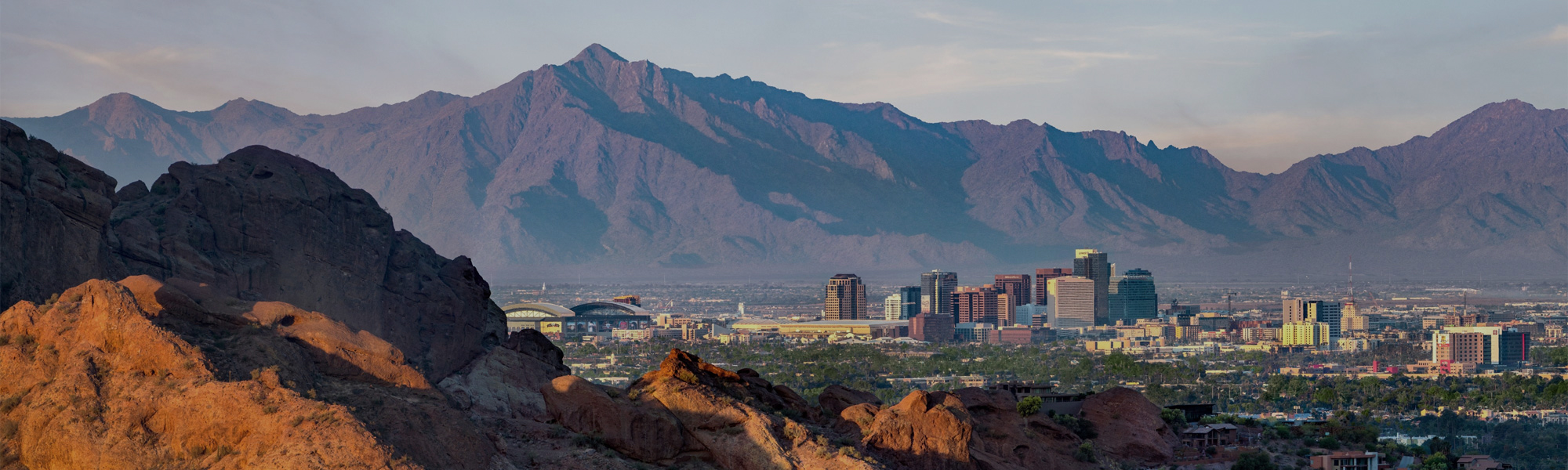
We represent injury clients across the Phoenix metro, from the West Valley out to Surprise and Peoria, through central Phoenix, and across the East Valley to Mesa, Chandler, and Gilbert. Jared J. Pehrson handles cases personally. You won’t get bounced through an intake pipeline or handed off to a paralegal you’ve never met. If your crash happened anywhere in Maricopa County, this is the page that tells you what we do, where we do it, and which laws apply to your claim no matter which city the wreck happened in. Below you’ll find direct links to our city-specific pages, the freeway corridors we work most, and a plain-English breakdown of the Arizona statutes every driver in our service area should know.
Every car accident claim in Arizona runs on the same statewide rulebook, but the practical shape of a case changes based on where it happened. A rear-end collision on Loop 101 near Bell Road draws a different crash report than the same wreck on a Tempe side street. A claim against a city bus in Mesa triggers a notice-of-claim deadline that a private driver collision does not. Maricopa County Superior Court is the venue for most lawsuits we file, so knowing the local judges, the local defense firms, and the local ADOT crash data isn’t optional. It’s table stakes.
Local also matters for medical care. The orthopedic specialists, imaging centers, pain management clinics, and physical therapists vary by city. We know which providers take liens, which ones bill insurance directly, and which ones produce records that hold up when an adjuster tries to pick them apart.
Each city below has a dedicated page with hyper-local information: where crashes cluster, which hospitals you’ll likely be treated at, and how local law enforcement handles reports. Click through for the city closest to where your crash happened.
West Valley
Central
East Valley
Don’t see your city on the list? We still likely serve you. Anything inside Maricopa County, plus parts of Pinal County, is fair game. Call us at (602) 345-1818 and we’ll tell you straight whether we’re the right fit.
Most serious metro crashes happen on a handful of recurring corridors. ADOT crash data has flagged these for years, and they show up disproportionately in our caseload.
Loop 101 (Agua Fria, Pima, and Price segments). The Bell Road, Northern Avenue, and Indian School Road interchanges produce elevated crash rates year-round. Rear-end and sideswipe collisions dominate. Speed differentials between merging traffic and through traffic are the usual culprit.
I-10 through Phoenix. The Stack Interchange (I-10 at I-17) and the Mini-Stack (I-10 at SR-202 and SR-51) are two of the highest-volume crash zones in the state. Multi-vehicle pileups during rush hour are common. So is reconstruction work that creates lane shifts.
US-60 (Superstition Freeway). Heavy commuter corridor through Tempe and Mesa. Rear-end accidents at Mill Avenue, Rural Road, and Country Club Drive spike during morning and evening commutes.
Loop 202 (Red Mountain, Santan, and South Mountain segments). The South Mountain extension opened newer traffic patterns that are still settling. Santan handles East Valley commuters who use it as an I-10 alternative.
SR-51 (Piestewa Freeway). Connects central Phoenix to the north valley. Tight curves near the Mini-Stack and Glendale Avenue exit produce single-vehicle and rear-end crashes.
If your crash happened on any of these, we’ve handled cases on that exact stretch of road before. That matters when it’s time to subpoena ADOT traffic data, pull DPS reports, or work with an accident reconstruction expert.
Our car accident practice covers the full range of motor vehicle injury claims. In every service city, we handle:
The injury types we see most often: whiplash and soft-tissue cervical injuries, herniated discs, traumatic brain injuries (including delayed-onset concussions), fractures, and complex regional pain syndrome.
This is the part most competitor service-area pages skip. The rules below apply uniformly across Phoenix, Mesa, Scottsdale, Tempe, Chandler, Gilbert, Peoria, Glendale, Surprise, and every other city we serve.
Two-year statute of limitations. Under A.R.S. § 12-542, you have 2 years from the date of the crash to file a personal injury lawsuit in Arizona. Miss it and your claim is dead, no matter how strong the liability or how severe the injury. The clock doesn’t pause because you’re still in treatment or still negotiating with the adjuster.
Comparative negligence. Arizona is a pure comparative negligence state under A.R.S. § 12-2505. Your damages are reduced in proportion to your percentage of fault, but you can still recover even if you’re mostly at fault. A plaintiff who is 99% at fault can still recover 1% of their damages. Read more on how Arizona’s comparative negligence rule plays out in real cases.
Minimum liability insurance. Arizona’s current minimum auto liability coverage is 25/50/15: $25,000 per person for bodily injury, $50,000 per accident for bodily injury, and $15,000 for property damage. Those minimums apply to policies issued or renewed beginning July 1, 2020. They’re low, which is exactly why uninsured and underinsured motorist coverage matters so much in real-world claims.
UM/UIM offering. Arizona insurers are required to offer uninsured and underinsured motorist coverage. Consumers can reject it, but the rejection has to be in writing. If you don’t remember signing a written rejection, you may have UM/UIM coverage you didn’t know about. We pull policy declarations on every case to check.
Here’s a deadline that catches people off guard. If your crash involves a city bus, a Maricopa County vehicle, a Phoenix Police cruiser, an ADOT roadway-defect claim, or any other state or municipal entity, A.R.S. § 12-821.01 requires you to file a written notice of claim within 180 days of the incident. Not 2 years. 180 days.
Miss that notice and the claim is barred, even though the underlying statute of limitations is longer. The notice has to contain specific information: the facts supporting liability, the damages claimed, and a specific sum certain for settlement. It has to be served on the correct entity. Get any of that wrong and the case can be dismissed.
If there’s any chance a government vehicle, government driver, or government-maintained roadway is connected to your crash, call us early. The 180-day window goes fast.
Yes. Our service area covers the entire Phoenix metro and most of Maricopa County. We also take cases in surrounding counties when the facts justify it. If you’re not sure whether we cover your area, call (602) 345-1818 and we’ll tell you in the first conversation.
Freeway crashes are usually handled by the Arizona Department of Public Safety (DPS), not city police. The DPS report becomes the foundational document for the claim. Jurisdiction follows the law of the crash, not the city boundary, so whether the wreck happened on Loop 101 in Scottsdale or on I-10 between Phoenix and Avondale, the same Arizona statutes apply. We pull DPS records on every freeway case.
Yes. We have a separate office presence in Albuquerque and handle injury cases throughout New Mexico. The deadlines and rules are different there (3-year personal injury statute of limitations under NMSA § 37-1-8, 90-day government notice under the NM Tort Claims Act). If your crash happened in NM, mention that when you call so we route you correctly.
Yes. The case review is free, and we work on contingency, which means no attorney’s fees unless we recover for you. Case costs and the specific fee terms are spelled out in the written fee agreement we go over with you before you sign anything.
Yes, in most situations. If you’re unhappy with how your current attorney is handling things, you can ask another firm for an opinion. There’s almost never a financial penalty to the client for switching, because fee splits typically happen between the attorneys, not out of your pocket. Specifics depend on the written agreements involved.
The sooner the better. Evidence disappears. Witnesses move. Skid marks fade. Surveillance footage gets overwritten on a 30-day loop. And if a government entity is involved, the 180-day notice clock is already running.
Wherever you are in the Valley, we’ll give you a straight read on your situation before you commit to anything. No pressure, no script. Just an honest conversation about what your claim looks like, what factors will drive its value, and what the next step should be.
Free case review: (602) 345-1818. We answer 24/7.
By Jared J. Pehrson | Impact Legal Car Accident Attorneys
A free conversation can help you understand your next step.